
Short answer: Uber Eats, DoorDash, Instacart, Gopuff, Walmart and Saucey all deliver alcohol in the United States, along with a long list of individual liquor stores and chains running delivery off their own websites. None of them cover the whole country. No two of them cover the same map.
That last part is the entire story. Alcohol delivery is not one national service with a few gaps in it. It is fifty separate legal regimes, plus counties, plus cities, plus whatever the specific store down the road is licensed to do. Which is why this question has a different answer in Cleveland than it does in Salt Lake City, and why the useful version of this page is a map rather than a ranking.
Who delivers alcohol right now
Uber Eats. Absorbed Drizly in 2024 and folded alcohol into the main app. Delivers beer, wine and spirits from liquor stores, grocery stores and participating restaurants across roughly thirty states.
DoorDash. Alcohol delivery in thirty states plus Washington DC and Puerto Rico, and it publishes the actual list, which is more than most of them do. Several of those states are partial. Nevada is Las Vegas and Henderson only. Wyoming is Cheyenne and Laramie only. In Minnesota, Tennessee and Washington the alcohol has to come from a store rather than a restaurant. Worth noting that alcohol is the only regulated category DoorDash carries, which is a different answer than the one for tobacco.
Instacart. Alcohol rides along with a grocery order, pulled from whichever partner retailers near you hold the right license. Total Wine, BevMo, Binny’s, Kroger, Albertsons and Publix have all run alcohol through it. Availability is set retailer by retailer, so two stores in the same city can give you two different answers.
Gopuff. Stocks its own micro-fulfillment centers instead of shopping a store, so the catalog is whatever that warehouse holds. Alcohol is live in many but not all of its markets, and its alcohol hours follow local licensing rather than its own opening hours.
Walmart. Beer and wine through walmart.com and the Walmart app in select markets, spirits in fewer of them, entirely depending on local law. Walmart’s own guidance is to enter your address and see what comes back, which is the correct answer and also a little bit of a dodge.
Saucey. Alcohol-first, in 49 markets, filled by independent local liquor stores rather than a warehouse or a grocery chain. Delivery is $4.99 and you see it at the start. More on that below, since we are obviously not a neutral party here.
The store itself. Total Wine, BevMo and plenty of independent shops run their own delivery or hand it to a courier service. If you already have a store you like, checking their site directly takes thirty seconds and skips a layer.
What happened to Drizly?
It is gone. Uber bought Drizly in 2021 for $1.1 billion, ran it as a standalone app for three years, then shut it down at the end of March 2024 and moved the whole marketplace into Uber Eats.
We wrote about it at the time in what happened to Drizly. It matters now mostly as a dating tool: if you land on a listicle that still recommends Drizly, that page has not been touched in over two years, and you can safely assume the rest of its facts have aged the same way.
Can you order alcohol on Walmart delivery?
Yes, in select markets. Beer and wine are the common case, spirits are available in fewer places, and both depend on what your state and city allow. You order through walmart.com or the Walmart app the same way you order paper towels, and the alcohol is verified separately at the door.
Two things worth knowing. Delivery windows for orders containing alcohol can be narrower than normal windows, because legal sale hours are narrower than store hours. And if the ID check fails at the door, Walmart’s policy is that the entire order goes back, not just the bottle. Your groceries are hostages.
Does Uber Eats allow scheduled alcohol delivery?
Uber Eats supports scheduled orders generally. Whether you can schedule one containing alcohol is a separate question, and your state and city answer it, not Uber.
Most jurisdictions will not let anyone deliver alcohol outside legal sale hours, so the app cannot offer you a window it is not allowed to fill. The practical effect is that scheduling can quietly vanish from a cart with alcohol in it while still being available for your burrito. If you need a specific window, add the alcohol first and see which slots survive.
How do you get free delivery on an alcohol order?
Usually by subscribing to something. That is true across the whole category, and we are not going to pretend we are the exception to it.
On Uber Eats it is Uber One. On DoorDash it is DashPass. On Saucey it is Saucey Club, $9.99 a month or $99 a year, which waives the delivery fee on orders over $25. Same mechanism in all three cases: pay a membership, stop paying per delivery. Promo codes also exist, and also expire.
What no membership waives is the service fee, or the item price itself, which on marketplace apps is often set above the shelf price at the store the order came from. Research tracking delivery-app menus against in-store menus across major restaurant brands has repeatedly put that gap in the range of fifteen to twenty percent, before a single fee is added. Nobody has published the same study for liquor stores, but the commission structure driving it is the same one.
There is a reason this works on all of us. Pricing researchers call it partitioned pricing: split one total into a base price plus a stack of surcharges, and people anchor on the base and mentally discount the rest. Marketplace apps are built on that anchor. The number that gets you to add to cart is not the number you pay.
So here are our numbers, since you can work them out yourself anyway. Saucey’s delivery fee is $4.99, plus applicable taxes and fees, and we show it to you at the start rather than springing it on you at the end. Against that, Saucey Club at $9.99 a month breaks even at two qualifying orders and puts you ahead at three. The $99 annual plan needs about twenty orders across the year, which works out a little under two a month. Order less often than that and you are better off skipping the membership and paying the $4.99 when you actually order. We would rather tell you that than sell you a subscription you never use.
Then do the honest test. Put the same bottle in two carts and read the number at the very bottom of each one, membership or no membership. The delivery fee is frequently the smallest line in the stack, and reliably the least interesting one.
What every alcohol delivery service does identically
Whoever you order from, three things are the same, and none of them are negotiable.
- Someone 21 or older has to be there. Alcohol cannot be left at the door. Contactless delivery does not apply to it anywhere in the United States.
- A real government-issued photo ID gets checked, and increasingly scanned. Expired does not count. A photo of your ID on your phone does not count. Your friend’s ID very much does not count.
- The driver can refuse. If the recipient appears intoxicated, the order goes back to the store. Drivers are trained on this, and in many states they carry personal liability for getting it wrong, so this is not a rule anyone is bending as a favor.
None of that is any one company being difficult. It is the condition on which every one of them is permitted to operate.
Why the app works for your friend and not for you
Alcohol is regulated at the state level, then again at the county level, and sometimes again at the city level. Every one of those layers can say no independently.
A state can permit delivery while a dry county inside it does not. Kentucky and Texas both have wet and dry counties cutting through them, which DoorDash calls out in its own merchant policy. A state can permit beer and wine but not spirits. A state can permit a licensed retailer to run its own deliveries while refusing to let a third-party app do the same job.
There is also a distinction most articles blur, and it is worth holding onto: delivery is a licensed retailer near you bringing something to your door today. Shipping is a winery or retailer mailing you a case across state lines, which runs on an entirely separate body of law with its own list of states. A page that treats those as the same thing is going to be wrong about at least one of them.
So when the app says nothing is available, the app is not broken. Your address just landed on the wrong side of a line that mostly got drawn in 1933 and has been edited ever since. We keep a running breakdown at states that allow alcohol delivery.
Where Saucey fits
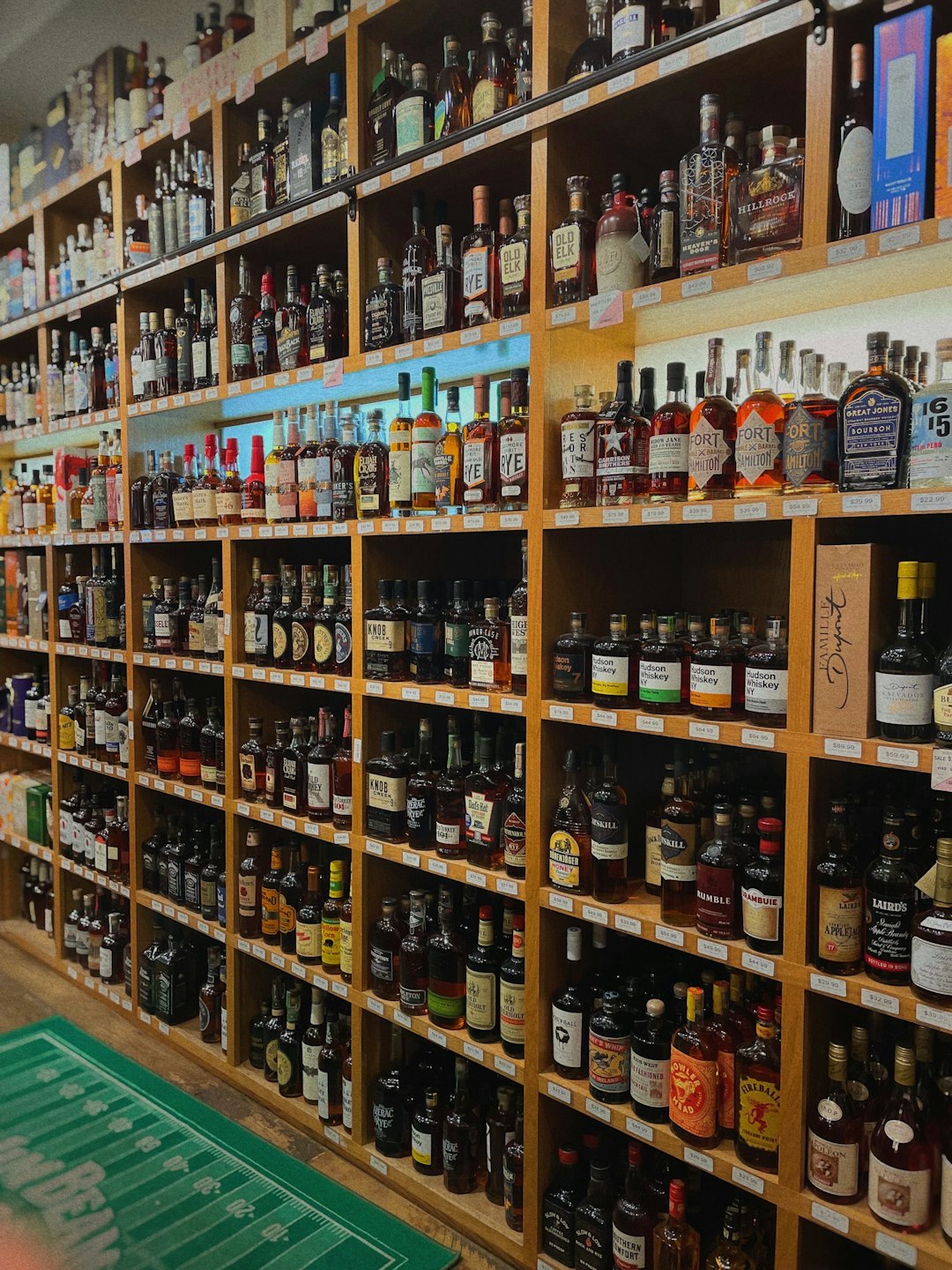
Saucey is alcohol-first. Not a food app with a liquor aisle bolted onto the side, not a grocery run that happens to allow wine. The catalog is beer, wine, liquor, mixers, snacks, ice and the rest of what a liquor store actually stocks.
There is a structural difference underneath that one, and it is the part worth knowing. Gopuff picks from its own warehouses. Instacart shops whichever chain nearby happens to hold a license. Saucey runs on a network of independent liquor stores, so your order gets filled by a neighborhood shop with an actual owner rather than a distribution center with a shift schedule.
We would love to tell you we built it that way purely out of civic virtue. That is honestly part of it. The other part is that independent bottle shops stock things a warehouse never will, and those are the bottles you actually came here for.
That is the real trade-off between the two models, stated plainly. A marketplace app gives you one cart for dinner and a six-pack. An alcohol-first service gives you the depth of an actual bottle shop. Which one you want depends on the night. If you are stocking for a group rather than an evening, how much alcohol to order for a party does the arithmetic so you don’t have to.
Orders arrive as fast as 25 minutes. That is a best case and we are not going to pretend otherwise. What actually shows up at your door and when depends on how far you are from the store, what time it is, and whether it happens to be the Saturday before a holiday, which is true of every delivery service that has ever existed.
Saucey currently delivers in these markets:
- Albany
- Arlington
- Atlanta
- Austin
- Bend
- Binghamton
- Boston
- Buffalo
- Champaign
- Chicago
- Cleveland
- Connecticut
- Dallas
- Des Moines
- Fort Worth
- Fresno
- Houston
- Inland Empire
- Jacksonville
- Kansas City
- Los Angeles
- Miami
- Midland
- Minneapolis
- New Jersey
- New York City
- Oceanside
- Omaha
- Orange County
- Orlando
- Palm Springs
- Phoenix
- Portland
- Rochester
- Sacramento
- San Antonio
- San Diego
- San Francisco
- San Jose
- Santa Barbara
- Seattle
- SF East Bay
- Silicon Valley
- South Bay LA
- St. Louis
- Tampa
- Tucson
- Vista
- Washington DC
The fine print
What is available depends on your address. Enter it and we’ll show you what’s in stock nearby. Alcohol is 21 and up. ID at the door, every time, no exceptions and no negotiating with the driver.