Hennessy is the largest cognac house in the world, founded in 1765 and responsible for roughly half of all cognac shipped. How you drink it depends mostly on which bottle you have, and Hennessy’s own advice on the subject is shorter than you would expect: “drink it the way you want.” This guide gives you the producer’s actual serving guidance, the BNIC’s tasting method, the long drinks Hennessy publishes with their exact measures, the classic cognac cocktails with their official IBA specs and histories, and a standard-drink count for every serve. For what cognac is and how it is made, start with What Type of Alcohol Is Hennessy?
Last verified September 14, 2026. Serving guidance is quoted from hennessy.com and the BNIC (the cognac trade body); cocktail specs are from hennessy.com and the International Bartenders Association; histories are from the Sazerac Company, Difford’s Guide and the sources listed at the end; standard drinks use the NIAAA definition with Hennessy at 40% and modifiers at the ABVs stated; calories from USDA FoodData Central.
| Serve | Hennessy’s own spec | Standard drinks |
|---|---|---|
| Neat or on ice | 1.5 oz; X.O “on a rock, on three rocks, over ice” | 1.0 |
| Hennessy Ginger | 1.5 oz V.S, 3.5 oz ginger ale, lime | 1.0 |
| Hennessy Cola | 1.5 oz V.S, 3.5 oz cola, lime wedge | 1.0 |
| Hennessy Mule | 1.5 oz V.S, 3.5 oz ginger beer, 0.5 oz lime juice | 1.0 |
| Sidecar (Hennessy’s version) | 1.5 oz V.S.O.P, 0.5 oz orange curaçao, 0.25 oz simple syrup, 0.75 oz lemon | 1.3 |
| Sidecar (IBA) | 50 mL cognac, 20 mL triple sec, 20 mL lemon | 1.6 with a 40% triple sec; 1.3 with a 15% one |
| Sazerac (IBA) | 50 mL cognac, 10 mL absinthe rinse, sugar cube, 2 dashes Peychaud’s | About 1.4 |
| Hennessy Margarita | 40 mL V.S, 20 mL lime, 15 mL orange liqueur, 5 mL agave syrup | 1.2 |
The range, briefly
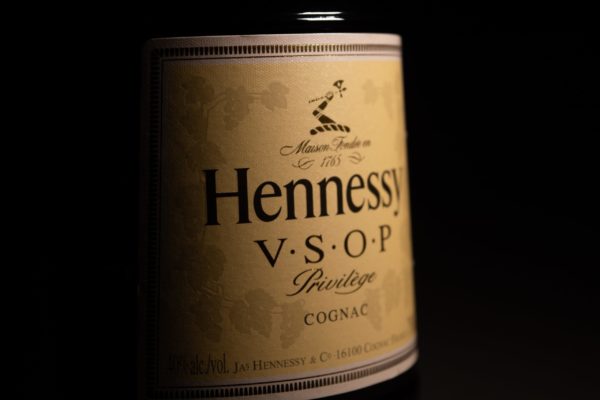
Cognac is labeled by the age of the youngest eau-de-vie in the blend, and the tiers set what people tend to do with each bottle. Hennessy V.S (at least 2 years in oak) is the one the house positions for cocktails and long drinks; Hennessy Black (43 percent, US only) is described by Hennessy as “perfect for cocktails”; V.S.O.P Privilège (at least 4 years) is the one Hennessy’s page says to drink “neat, on ice, on the rocks or in a sublime range of long drinks and cocktails”; X.O (at least 10 years) gets three ice serves on its own page; Paradis and Richard Hennessy sit above X.O with no age statement. All are 40 percent except Black and the Master Blender’s Selection bottlings at 43. The full lineup with sizes and dates is on the type-of-alcohol page.
What Hennessy says about glasses and serves
Hennessy’s US FAQ is the closest thing to an official rulebook, and it refuses to be one. On glassware: “Hennessy recommends that a special glass be used to serve its cognacs: the one you want!” On method: “There is just one rule for drinking cognac: drink it the way you want,” and “Our cognacs can be served neat, over ice, diluted with a bit of water or they can be used in cocktails.” On ice specifically: “When enjoyed with ice, their identity is strong enough to withstand dilution.” The FAQ’s two concrete suggestions are “Hennessy V.S with ginger ale or tonic water, or Hennessy X.O on 3 ice cubes.” On storage: keep the bottle upright, opened or not, in a dark place at room temperature, and do not expect it to age in the bottle, because cognac stops aging the day it leaves the cask.
The BNIC, the body that governs the cognac appellation, is a little more specific about tasting. Serve it neat “in a tulip or stem glass,” because the narrow rim holds the aromas, and taste in three steps: look (tilt the glass and watch the color and the tears), nose (rotate the glass to aerate it), then palate (“Take a small sip of Cognac, chew it, then take in some air”). Neither Hennessy nor the BNIC publishes a serving temperature or a pour size. The one thing Hennessy does rule out, on its myth-busting page, is warming a snifter over a flame; cupping the glass in your hand does the same job without cooking the spirit.
Neat, with water, or on ice
The practical version of all that. A 1.5 oz pour at room temperature in a tulip glass is the tasting serve and is one standard drink. A few drops of water is a serve the BNIC lists and many blenders use; it lowers the strength slightly and changes nothing about the count. Ice is the serve Hennessy pushes hardest for X.O, with its “On a rock, on three rocks, over ice” page, and for V.S it is the base of every long drink below. Ice dilutes as it melts, so a rocks pour drinks lighter as it goes, but the alcohol you poured is the alcohol you drink.
Hennessy’s long drinks, with the measures
These are the producer’s published recipes, from hennessy.com, not ours. Every one of them is built on 1.5 oz of Hennessy V.S, which is exactly one standard drink, and a 3.5 oz mixer. The mixer is where the calories and sugar come from: USDA puts regular cola at about 13 calories per fluid ounce, so a Hennessy Cola is about 142 calories against 97 for the cognac alone.
| Drink | Hennessy’s spec | Glass and garnish | Standard drinks |
|---|---|---|---|
| Hennessy Ginger | 1.5 oz V.S, 3.5 oz ginger ale | Balloon glass with ice, lime wedge | 1.0 |
| Hennessy Cola | 1.5 oz V.S, 3.5 oz cola | Rocks glass with ice, lime wedge | 1.0 |
| Hennessy Mule | 1.5 oz V.S, 3.5 oz ginger beer, 0.5 oz lime juice | Iced rocks glass, lime wedge | 1.0 |
| Hennessy Apple | 1.5 oz V.S, 3.5 oz apple juice | Rocks glass with ice, apple wedge or cinnamon stick | 1.0 |
| Hennessy Pineapple | 1.5 oz V.S, 3.5 oz pineapple juice, 1 dash bitters | Balloon glass with ice, lime wedge | 1.0 |
| Hennessy Honey Highball | 1.5 oz V.S, 0.5 oz honey syrup, 0.5 oz lemon juice, 4 oz club soda | Highball with ice, lemon twist | 1.0 |
| Paloma | 1.5 oz V.S.O.P, 0.75 oz grapefruit juice, 0.25 oz agave syrup, 2 oz soda water | Collins glass with ice, grapefruit wedge | 1.0 |
| Horse’s Neck | 1.5 oz V.S.O.P, 4 dashes Angostura bitters, 4.5 oz ginger ale | Highball with ice, long lemon peel | 1.0 |
The classic cognac cocktails
Sidecar
The Sidecar is the reference cognac cocktail and one of the IBA’s Unforgettables. The IBA spec, verbatim: “50 ml Cognac, 20 ml Triple Sec, 20 ml Fresh Lemon Juice. Pour all ingredients into cocktail shaker, shake well with ice, strain into chilled cocktail glass.” Hennessy’s own version, on hennessy.com, is 1.5 oz V.S.O.P, 0.5 oz orange curaçao, 0.25 oz simple syrup and 0.75 oz lemon juice, shaken and strained with a lemon twist. A sugar rim is optional in both. The strength depends on the orange liqueur: with Cointreau (40 percent) the IBA Sidecar is 1.6 standard drinks; with a 15 percent triple sec it is 1.3. Hennessy’s spec comes to 1.3.
It was first printed in 1922, in both Robert Vermeire’s Cocktails: How to Mix Them (which credits “MacGarry, the celebrated bar-tender of Buck’s Club” in London) and Harry MacElhone’s ABC of Mixing Cocktails. There is a “French school” of equal parts and an “English school” of 2:1:1 from the 1930 Savoy Cocktail Book; the IBA’s 50/20/20 is closer to the English one. Difford’s Guide’s conclusion is that “we will probably never know who created/named the Sidecar.” The BNIC dates it to 1920.
Sazerac
The Sazerac is a cognac drink in the IBA’s book, and it was a cognac drink to begin with. IBA spec, verbatim: “50 ml Cognac, 10 ml Absinthe, 1 Sugar Cube, 2 Dashes Peychaud’s Bitters. Rinse a chilled old-fashioned glass with the absinthe, add crushed ice and set it aside. Stir the remaining ingredients over ice in a mixing glass. Discard the ice and any excess absinthe from the prepared glass, strain the mixed drink into the glass.” Garnish with lemon zest. The IBA’s own note: “The original recipe changed after the American Civil War, Rye Whiskey substituted Cognac as it became hard to obtain.” With the absinthe counted in full it is about 1.4 standard drinks; a rinse that is discarded leaves closer to 1.2.
The Sazerac Company’s account: Bernard Sazerac de Forge founded a cognac house in France in 1782, and “Sazerac de Forge et Fils was the original spirit used in the Sazerac Cocktail.” The Sazerac House coffee house in New Orleans is documented in 1852; Antoine Peychaud advertised his bitters as “introduced into use at the Sazerac House” in 1857; Thomas H. Handy bought the bar in 1869. When the phylloxera louse destroyed French vineyards and cognac became scarce, New Orleans bartenders switched to American rye; the Sazerac Company’s timeline gives 1885 for the switch, other accounts say around 1870. After the US absinthe ban in 1912, Herbsaint became the New Orleans rinse. The first printed recipe is in Boothby’s 1908 book, and on June 23, 2008 the Louisiana Legislature named the Sazerac the official cocktail of New Orleans. Making it with Hennessy V.S.O.P is making it the original way.
Cognac Old Fashioned
The IBA Old Fashioned is a whiskey drink: “45 ml Bourbon or Rye Whiskey, 1 Sugar Cube, Few Dashes Angostura Bitters, Few Dashes Plain Water,” muddled in the glass, filled with ice, whiskey added and stirred, with an orange slice or zest and a cherry. A cognac Old Fashioned is a substitution, not an IBA drink, and it works the same way: stir 2 oz Hennessy V.S.O.P with 0.25 oz demerara or simple syrup, 2 dashes Angostura and 1 dash orange bitters over ice, strain over a large cube, and garnish with orange peel. At 2 oz that is 1.3 standard drinks. The “cocktail” itself was defined in print in 1806 as spirits, bitters, water and sugar, which is this drink; the Pendennis Club origin story is contradicted by an 1880 Chicago Daily Tribune reference to “old fashioned cocktails,” a year before the club was founded.
Hennessy Margarita
Hennessy publishes its own: 40 mL V.S, 20 mL fresh lime juice, 15 mL orange liqueur and 5 mL agave syrup, shaken and served in a salt-rimmed rocks glass over ice with a lime wedge. With a 40 percent orange liqueur that is 1.2 standard drinks. The US site also carries a co-branded “Henny-Rita” (1.5 oz cognac, 0.5 oz orange liqueur, 0.5 oz lime, 1 oz orange juice, 1 tablespoon agave, hibiscus-salt rim) at 1.3. Our standard margarita recipe is the tequila reference point.
Hennessy Manhattan
Hennessy’s spec: 1.5 oz V.S.O.P, 0.75 oz sweet vermouth, 2 dashes Angostura, stirred and strained into a coupe or over ice, orange twist. With vermouth at 16 percent that is 1.2 standard drinks.
Standard drinks, all serves
NIAAA defines a standard drink as 0.6 fl oz of pure alcohol, which is a 1.5 oz pour of a 40 percent spirit. Every 1.5 oz pour of Hennessy V.S, V.S.O.P, X.O or Paradis is therefore exactly one, and Black at 43 percent is 1.08. The cocktails climb because of the second spirit or liqueur. Formula: add up (fluid ounces x ABV) for each ingredient and divide by 0.6.
| Serve | Alcohol in the glass | Standard drinks |
|---|---|---|
| 1.5 oz Hennessy V.S, V.S.O.P or X.O, neat or on ice | 0.60 oz | 1.0 |
| 1.5 oz Hennessy Black (43%) | 0.65 oz | 1.08 |
| 2 oz pour, neat | 0.80 oz | 1.3 |
| Any Hennessy long drink (1.5 oz V.S plus mixer) | 0.60 oz | 1.0 |
| Hennessy Sidecar | 0.80 oz | 1.3 |
| IBA Sidecar with Cointreau | 0.95 oz | 1.6 |
| Hennessy Margarita | 0.74 oz | 1.2 |
| Hennessy Manhattan | 0.72 oz | 1.2 |
| Cognac Old Fashioned (2 oz) | 0.80 oz | 1.3 |
| IBA Sazerac (absinthe counted in full) | 0.86 oz | 1.4 |
| Between the Sheets (Hennessy’s spec: 1 oz each cognac, rum, curaçao) | 1.20 oz | 2.0 |
Frequently asked questions
How do you drink Hennessy? Hennessy’s own answer is neat, over ice, with a little water, or in cocktails, in whatever glass you like. Its two named suggestions are V.S with ginger ale or tonic and X.O on three ice cubes.
What glass should you use? Hennessy says “the one you want.” The BNIC recommends a tulip or stem glass for tasting neat because the narrow rim holds the aroma.
Should Hennessy be chilled or warmed? Neither the producer nor the BNIC publishes a serving temperature. Hennessy’s myth page says not to warm a snifter over a flame; your hand is enough.
What do you mix Hennessy with? Hennessy publishes recipes with ginger ale, cola, ginger beer, apple juice, pineapple juice, tonic, soda and honey, all at 1.5 oz cognac to about 3.5 oz mixer.
Is a Sidecar a cognac drink? Yes. The IBA spec is 50 mL cognac, 20 mL triple sec, 20 mL lemon juice, and it was first printed in 1922.
Was the Sazerac originally made with cognac? Yes, with Sazerac de Forge et Fils cognac. Rye replaced it in the 1870s or 1880s when phylloxera made cognac scarce, and the IBA’s current spec is back to cognac.
How many standard drinks is a glass of Hennessy? One, for a 1.5 oz pour at 40 percent. A 2 oz pour is 1.3.
Sources
- Hennessy USA, FAQs (glassware, serves, storage), Hennessy, What to know about Hennessy X.O and Busting six myths about Hennessy cognac, checked September 14, 2026
- Hennessy cocktail pages: index, Hennessy Ginger, Hennessy Cola, Hennessy Mule, Hennessy Apple, Hennessy Pineapple, Honey Highball, Paloma, Horse’s Neck, Sidecar, Hennessy Margarita, Henny-Rita, Manhattan, Between the Sheets, checked September 14, 2026
- BNIC, Drinking cognac, How to taste cognac and Cocktails, checked September 14, 2026
- IBA official cocktails: Sidecar, Sazerac, Old Fashioned, checked September 14, 2026
- Sazerac Company, Our story (timeline), Sazerac Company, Old Sazerac de Forge, Sazerac House, How the Sazerac became the official cocktail of New Orleans, NPR, New Orleans declares Sazerac its cocktail of choice (June 26, 2008) and Wikipedia, Sazerac (Boothby 1908; c. 1870 switch), checked September 14, 2026
- Difford’s Guide, Sidecar cocktail history and Wikipedia, Old fashioned (1806 definition, 1880 Tribune, 1888 Proulx), checked September 14, 2026
- NIAAA, What is a standard drink; USDA FoodData Central, distilled spirits 80 proof (174815) and cola, regular (174852), checked September 14, 2026
Saucey carries Hennessy V.S, Black, V.S.O.P and X.O in most of the cities we serve, with delivery in as fast as 25 mins. Browse Hennessy on Saucey.
The fine print
What is available depends on your address. Enter it and we will show you what is in stock nearby: beer, wine, spirits, mixers and snacks. Delivery is $4.99, plus applicable taxes and fees, shown before you order, as fast as 25 minutes in the best case. Alcohol is 21 and up. ID at the door, every time, no exceptions and no negotiating with the driver.